
Recently, my small group studied of the book of Ruth.
I will present the assembled study here over the next several posts, but let me first provide a some background to the story of Ruth. The book itself has a significant lesson regarding what a kinsman redeemer is, but it may seem to some readers like it was placed in the bible at a whim.
In The Beginning....
Obviously, you have to start from the start.
The first 11 chapters of Genesis sets the foundation. In those chapters you have:
Chapters 1 and 2 Creation story.Chapter 3 The sinful fall of mankind and Adam and Eve's removal from paradise (Eden).Chapter 4 Evidence of the sinfulness of mankind (Envy, Anger, Murder).
Chapter 5 Population of the earth through Adam to Noah's time.
Chapters 6 though 9 Depopulation of the earth but saving Noah from the flood.
Chapter 10 Repopulation of the earth through Noah's lineage.
Chapter 11 Tower of Babel, the confusion of language, division and dispersion of the people, and the introduction of Abram.
The Sumerian City of Ur of the Chaldeans
In Genesis 12, God calls Abram out from his home in Ur, an ancient city of the Chaldeans.
Now the Lord said to Abram, “Go from your country and your kindred and your father's house to the land that I will show you. And I will make of you a great nation, and I will bless you and make your name great, so that you will be a blessing. I will bless those who bless you, and him who dishonors you I will curse, and in you all the families of the earth shall be blessed.”Genesis 12:1-3
According to Britannica.com:
Ur, important city of ancient southern Mesopotamia (Sumer), situated about 140 miles (225 km) southeast of the site of Babylon and about 10 miles (16 km) west of the present bed of the Euphrates River. In antiquity the river ran much closer to the city; the change in its course has left the ruins in a desert that once was irrigated and fertile land.
The Abrahamic Covenant
God promised Abram land, a multitude of descendants, that he would be blessed, that those who blessed him would be blessed, that those who cursed him would be cursed, and that all the families on the earth would be blessed because of him. Of particular interest, Abram was already seventy-five years of age, married, and had no children and yet God was promising that he would be the father of a great nation.
In Genesis 12:4-9, Abram made his way to the land God promised. Genesis 13 and 14 retell fascinating tales of Abram, his nephew Lot, instances of amazing combat of various kings, and introduces the mysterious priest-king, Melchizedek.
Then in Genesis 15, God formally initiates the covenant with Abram. See my article Blood Covenant - Part 1 for the amazing details regarding this covenant and the stunning goodness and graciousness of God.
Of pertinent note in Genesis 15 is:
Then the Lord said to Abram, “Know for certain that your offspring will be sojourners in a land that is not theirs and will be servants there, and they will be afflicted for four hundred years.
Genesis 15:13
The story of Genesis continues the biography of Abram (meaning 'exalted father') who God renamed Abraham (meaning 'father of multitudes'). It introduces Abraham's sons (Isaac in particular), and his grandsons (Jacob in particular). Jacob is later renamed Israel by God. Israel in turn had twelve sons that became the Twelve Tribes of Israel. Joseph, the next to youngest son and Israel's favorite son, was hated by his brothers. He was sold by them into slavery and taken into Egypt where through God's blessings he rose from slavery to become commander over all of Egypt second only to Pharaoh.
You Are Now Entering Egypt
During that time, a great famine spread throughout the region and various people from the surrounding areas came to the Egyptian kingdom for food and provisions including the sons of Israel - Joseph's brothers. After a wonderful story of reconciliation between Joseph and his brothers, Joseph called for Israel and the rest of his family to come live in Egypt to be saved from the famine.
This began the fulfillment of God's prophecy to Abraham regarding those four hundred years his descendants would be afflicted servants. It begins in Gen 50:22-26 where we read:
So Joseph remained in Egypt, he and his father's house. Joseph lived 110 years. And Joseph saw Ephraim's children of the third generation. The children also of Machir the son of Manasseh were counted as Joseph's own. And Joseph said to his brothers, “I am about to die, but God will visit you and bring you up out of this land to the land that he swore to Abraham, to Isaac, and to Jacob.” Then Joseph made the sons of Israel swear, saying, “God will surely visit you, and you shall carry up my bones from here.” So Joseph died, being 110 years old. They embalmed him, and he was put in a coffin in Egypt.
Then in Exodus 1:8-12, we learn that the descendants of Israel were oppressed by the Egyptians who feared them.
Now there arose a new king over Egypt, who did not know Joseph. And he said to his people, “Behold, the people of Israel are too many and too mighty for us. Come, let us deal shrewdly with them, lest they multiply, and, if war breaks out, they join our enemies and fight against us and escape from the land.” Therefore they set taskmasters over them to afflict them with heavy burdens. They built for Pharaoh store cities, Pithom and Raamses. But the more they were oppressed, the more they multiplied and the more they spread abroad. And the Egyptians were in dread of the people of Israel.
You're Now Leaving Egypt
Exodus 2 begins telling the story of Moses born some four hundred years after Joseph. Moses, an Israelite, was raised in the house of Pharaoh. After forty years, he fled Egyptian retribution by fleeing into the land of Midian after murdering an Egyptian for beating a fellow Hebrew. Forty years later, Moses famously encountered God, I AM, through the burning bush in the Midian wilderness. God commissioned him and and sent him back to Egypt to stand before Pharaoh as God rescued the Israelites.
Exodus 12:31 begins the story of the Israelites leaving Egypt and captivity and into the wilderness beyond the Red Sea.
[Note: I hope in the future to write an article showing how the plagues of Egypt weren't just a show of God's ultimate power and authority to the Egyptians and the Israelites, but also His wrathful judgements on the gods of Egypt who were demons (Leviticus 17:7, Deuteronomy 32:17). That should be a post all its own.]
In Leviticus, God gave His law to them in the wilderness at Mount Sinai.
"You shall not do as they do in the land of Egypt, where you lived, and you shall not do as they do in the land of Canaan, to which I am bringing you. You shall not walk in their statutes. You shall follow my rules and keep my statutes and walk in them. I am the Lord your God."Leviticus 18:3-4“Do not make yourselves unclean by any of these things, for by all these the nations I am driving out before you have become unclean, and the land became unclean, so that I punished its iniquity, and the land vomited out its inhabitants. But you shall keep my statutes and my rules and do none of these abominations, either the native or the stranger who sojourns among you (for the people of the land, who were before you, did all of these abominations, so that the land became unclean), lest the land vomit you out when you make it unclean, as it vomited out the nation that was before you. For everyone who does any of these abominations, the persons who do them shall be cut off from among their people. So keep my charge never to practice any of these abominable customs that were practiced before you, and never to make yourselves unclean by them: I am the Lord your God.”Leviticus 18:24-30“You shall therefore keep all my statutes and all my rules and do them, that the land where I am bringing you to live may not vomit you out. And you shall not walk in the customs of the nation that I am driving out before you, for they did all these things, and therefore I detested them."Leviticus 20:22-23
In the book of Numbers, the author relays various events that occurred to the Israelites in the wilderness.
Then in Deuteronomy, God repeats the law He gave to them. During this time, God warned them very pointedly and specifically about not adopting the ways of Egypt (where they had been called out of) or the Canaanites (where they were being led).
What were these things that were practiced by Egypt and the Canaanites that God so hated? Read all of Leviticus chapters 18 and 20 to find out.
By the end of Deuteronomy, God led the Israelites to the border of the land He had promised Abraham, Isaac, and Jacob. The last chapter relates the death of Moses.
The book of Joshua opens with God raising Joshua as leader in Moses' place.
On that day the Lord exalted Joshua in the sight of all Israel, and they stood in awe of him just as they had stood in awe of Moses, all the days of his life.Joshua 4:14
By the power of God working through Joshua, just as God had worked through Moses, the waters of the Jordan River at flood stage parted into columns so that allowed the Israelites to walk into the promised land across dry ground. What beautiful book-ends in that God provided a miraculous escape from slavery and provided the route into His promise just as He provides us with freedom from slavery to sin and provides us the route into His promise of eternal life through faith in Christ.
A New Home
The first location the Israelites conquered was the city outpost of Jericho. Before entering the promised land, Joshua sent two spies to gather intel on the land. Living in Jericho was a woman, a prostitute, named Rahab. She had hidden and protected the two Israelite spies from being discovered and killed by the soldiers of Jericho. In return, she received the promise that she and her family within her house would be spared.
When the promised land was conquered [mostly, the Israelites didn't fully eject the Canaanites as they were commanded], they lived tribally, and we we are taken into the book of Judges where it is repeated:
"In those days there was no king in Israel. Everyone did what was right in his own eyes."Joshua 17:6, 21:25
You can read through the book of Judges and see just how evil the people became time and again between being instances of being rescued by the judges that God raised up when they would turn to Him and cry out in despair.
Note: If you aren't familiar with the book of Judges, be warned that there are some disturbing stories relayed in the book of Judges that show to what levels of depravity the people of Israel sank to.
At the start of the book of Judges, Joshua and his generation had all died. The scripture then says that a generation arose after them that "did not know the Lord or the work He had done for Israel".
And the people of Israel did what was evil in the sight of the Lord and served the Baals. And they abandoned the Lord, the God of their fathers, who had brought them out of the land of Egypt. They went after other gods, from among the gods of the peoples who were around them, and bowed down to them. And they provoked the Lord to anger. They abandoned the Lord and served the Baals and the Ashtaroth. So the anger of the Lord was kindled against Israel, and he gave them over to plunderers, who plundered them. And he sold them into the hand of their surrounding enemies, so that they could no longer withstand their enemies. Whenever they marched out, the hand of the Lord was against them for harm, as the Lord had warned, and as the Lord had sworn to them. And they were in terrible distress. Then the Lord raised up judges, who saved them out of the hand of those who plundered them. Yet they did not listen to their judges, for they whored after other gods and bowed down to them. They soon turned aside from the way in which their fathers had walked, who had obeyed the commandments of the Lord, and they did not do so. Whenever the Lord raised up judges for them, the Lord was with the judge, and he saved them from the hand of their enemies all the days of the judge. For the Lord was moved to pity by their groaning because of those who afflicted and oppressed them. But whenever the judge died, they turned back and were more corrupt than their fathers, going after other gods, serving them and bowing down to them. They did not drop any of their practices or their stubborn ways. So the anger of the Lord was kindled against Israel, and he said, “Because this people have transgressed my covenant that I commanded their fathers and have not obeyed my voice, I will no longer drive out before them any of the nations that Joshua left when he died, in order to test Israel by them, whether they will take care to walk in the way of the Lord as their fathers did, or not.” So the Lord left those nations, not driving them out quickly, and he did not give them into the hand of Joshua.Judges 2:11-23
God had warned them ahead of time:
You shall not do according to all that we are doing here today, everyone doing whatever is right in his own eyesDeuteronomy 12:8
But Israel didn't keep the warning in mind:
In those days there was no king in Israel; everyone did what was right in his own eyes.Judges 17:6 (also 21:25)
Jeremiah, and then later Solomon, add understanding of why this lead to the depravity of Israel.
The heart is deceitful above all things, and desperately sick; who can understand it?Jeremiah 17:9
There is a way that seems right to a man, but its end is the way to death.Proverbs 14:12 (also, 16:25)
And this was the state of Israel for over 300 years during the time of the Judges set roughly from 1380 to 1050 BC. To place this relatively loosely in historical perspective, Rome was a small agrarian settlement and wouldn't become a kingdom for several hundreds of years, and the mysterious city-state of Troy had not yet been sacked by the Greeks using the [presumed] ruse of the Trojan Horse.
In The Rearview Mirror
One last bit from Genesis to tie it all in with Ruth.
Ruth is described as a Moabite (or Moabitess). As mentioned earlier, when Abraham had left Ur and travelled to the land promised to him by God, he brought his nephew Lot along. In the incident of Sodom, Gomorrah, and the other cities of the valley, Lot and his two daughters fled to safety in the mountains. The story then relates how the two daughters contrived a twisted plan to birth children by their father. The eldest daughter conceived and bore a son whom she named Moab (meaning "of his father").
The firstborn bore a son and called his name Moab. He is the father of the Moabites to this day.Genesis 19:37
Additionally, Lot's younger daughter had conceived by him and named her son Ben-ammi (meaning "son of my people") who became the patriarch of the Ammonites that were also enemies of Israel.
The younger also bore a son and called his name Ben-ammi. He is the father of the Ammonites to this day.Genesis 19:38
After that time, Abraham's wife, Sarah, gave birth to Isaac. Isaac's wife, Rebekah, gave birth to Esau and Jacob. Jacob had twelve sons including two by his wife Rachel: Joseph and Benjamin. We have already covered the story of Joseph and the Israelites in Egypt.
During the Israelite's four hundred year residency in Egypt during which their population grew to numbers that caused the Egyptians to be concerned, Moab also sired a nation. The land of the Moabites was on the eastern side of the Salt Sea (also known as the Dead Sea). It would be directly opposite of the portion of land allotted to the tribe of Judah. Moab was often an oppressor and combatant of Israel.
Similarly to the Moabites and the Ammonites, the Edomites (descendants of Edom, another name for Esau) and the Midianites (descendants of Midian, a son of Abraham by his second wife Keturah) were also often oppressors and enemies of Israel.
[The divided kingdom and the surrounding nations]
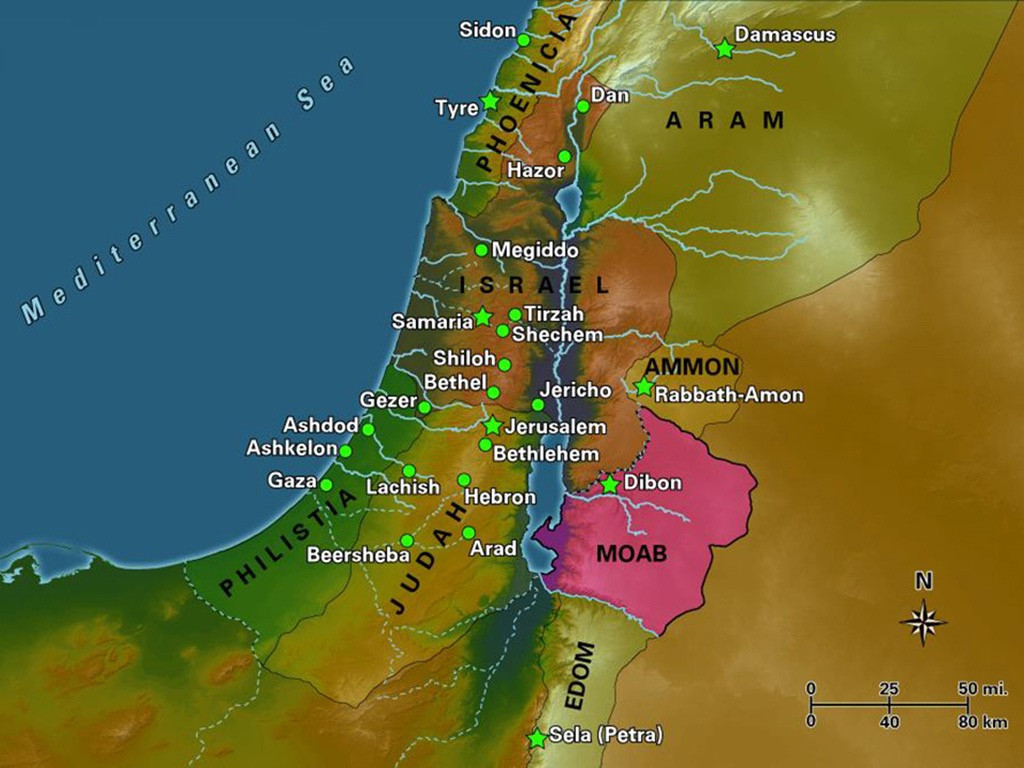
(Image Source: https://media.freebibleimages.org/stories/FB_Bible_Maps_SBL/source-jpeg/06_FB_Bible_Maps_SBL_1024.jpg?1613141123)
After the time of Abraham, Isaac, and Jacob, for well over four hundred years of Egyptian residency and forty years of wandering in the desert, the distantly related Moabites, Midianites, Edomites, and Ammonites grew in number and power.
So also did inhabitants of Canaan such as Amalekites, Jebusites, Girgashites, Hittites, Amorites, Perizzites, Hivites, and Philistines that the Israelites had to face and battle in execution of God's judgement.
As Moses led the Israelites toward the promised land, they met military resistance from some of these people and overcame them. Balak, the king of Moab, fearing the Israelites counselled with the Midianites. Balak summoned the seer Balaam to curse Israel which failed and he could only bless them.
By the time the Israelites reached Jericho, the stories of Israel's victorious battles along the way struck substantial fear of them among the Canaanites. Rahab, the former prostitute of Jericho, told the two spies she aided:
“I know that the Lord has given you the land, and that the fear of you has fallen upon us, and that all the inhabitants of the land melt away before you."Joshua 2: 9
You Are Here
And finally.... This is where we tie-in and pick up with the book of Ruth.
We learn that the timeline of Ruth occurs during the early years of the Judges by comparing the genealogy at the end of Ruth chapter 4 and the genealogy of Matthew chapter 1. Rahab was the mother of Boaz, and Boaz is the co-star of the book of Ruth.
Now these are the generations of Perez: Perez fathered Hezron, Hezron fathered Ram, Ram fathered Amminadab, Amminadab fathered Nahshon, Nahshon fathered Salmon, Salmon fathered Boaz, Boaz fathered Obed, Obed fathered Jesse, and Jesse fathered David.Ruth 4:18-22
Abraham was the father of Isaac, and Isaac the father of Jacob, and Jacob the father of Judah and his brothers, and Judah the father of Perez and Zerah by Tamar, and Perez the father of Hezron, and Hezron the father of Ram, and Ram the father of Amminadab, and Amminadab the father of Nahshon, and Nahshon the father of Salmon, and Salmon the father of Boaz by Rahab, and Boaz the father of Obed by Ruth, and Obed the father of Jesse, and Jesse the father of David the king.Matthew 1:2-6
Next: A Study of Ruth - Part 1
-----


 Posts
Posts

